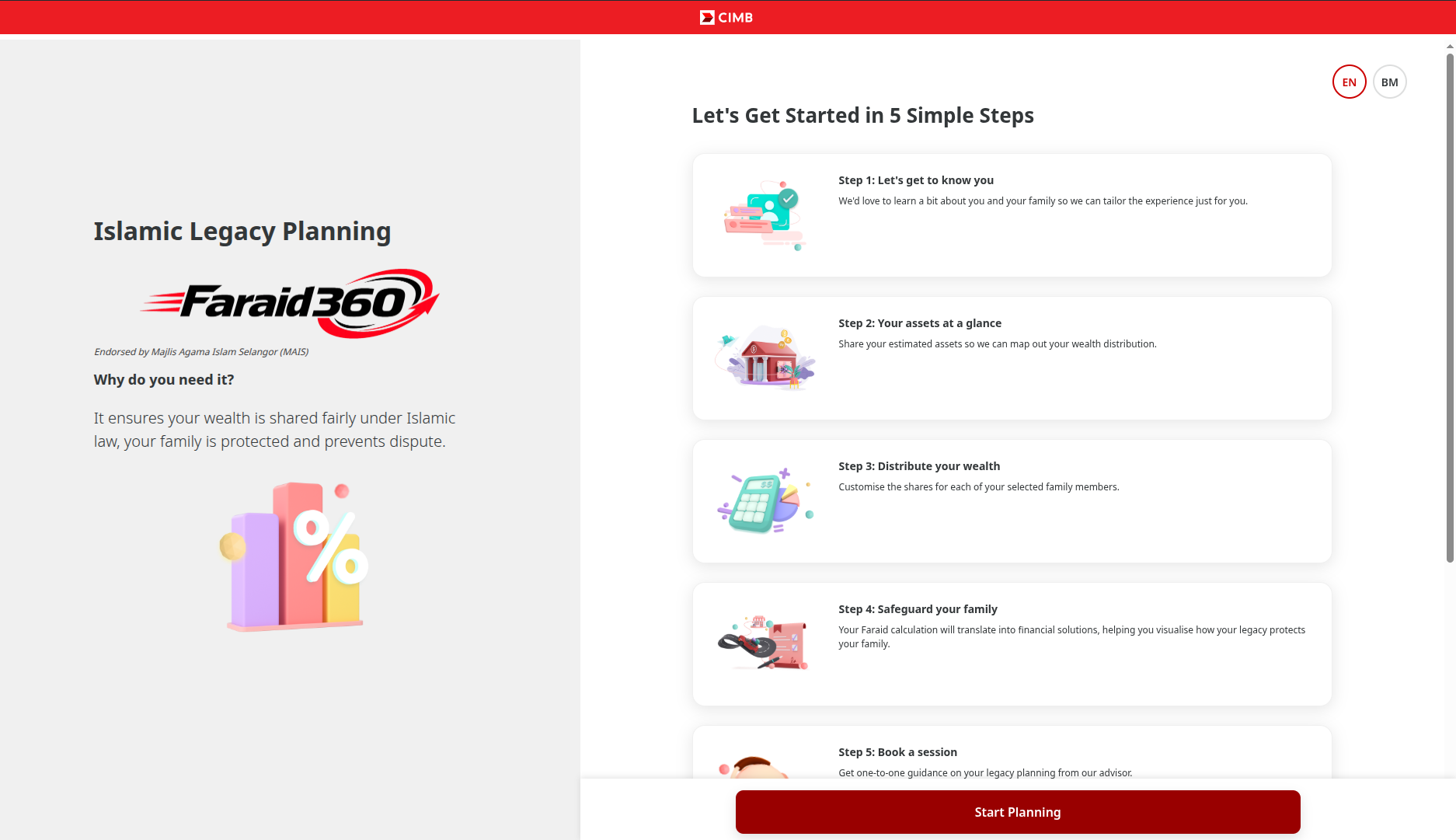
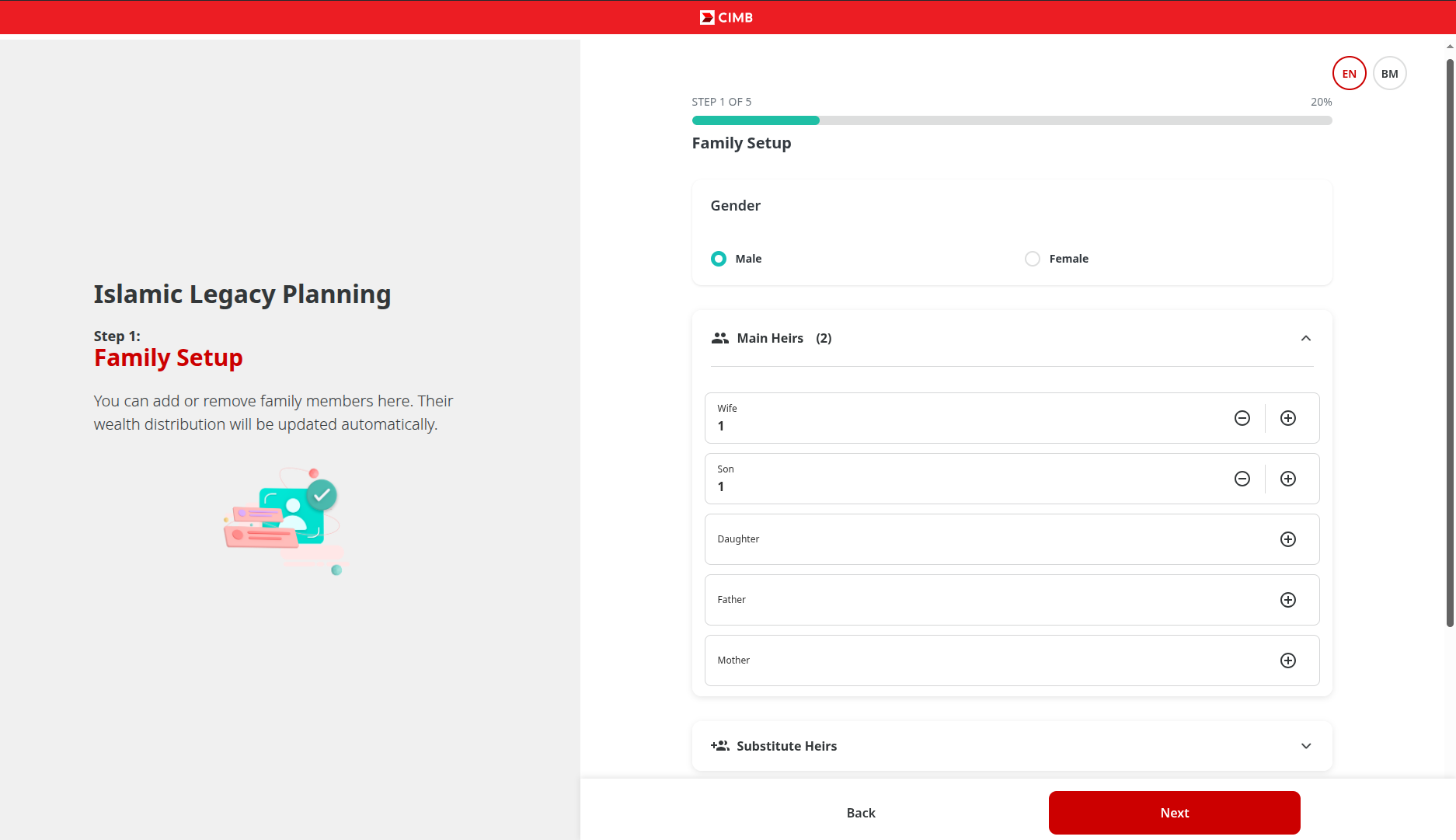
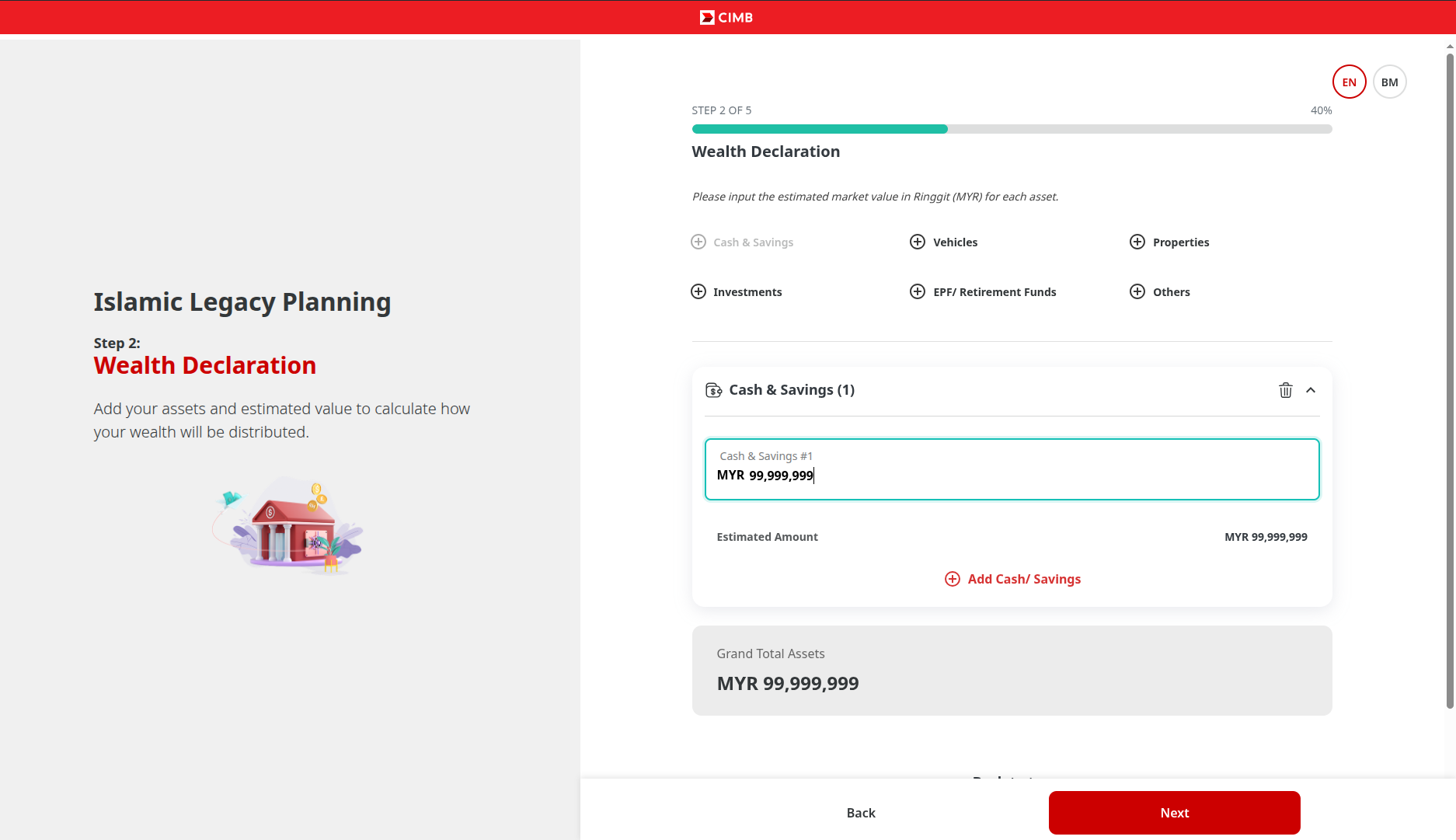
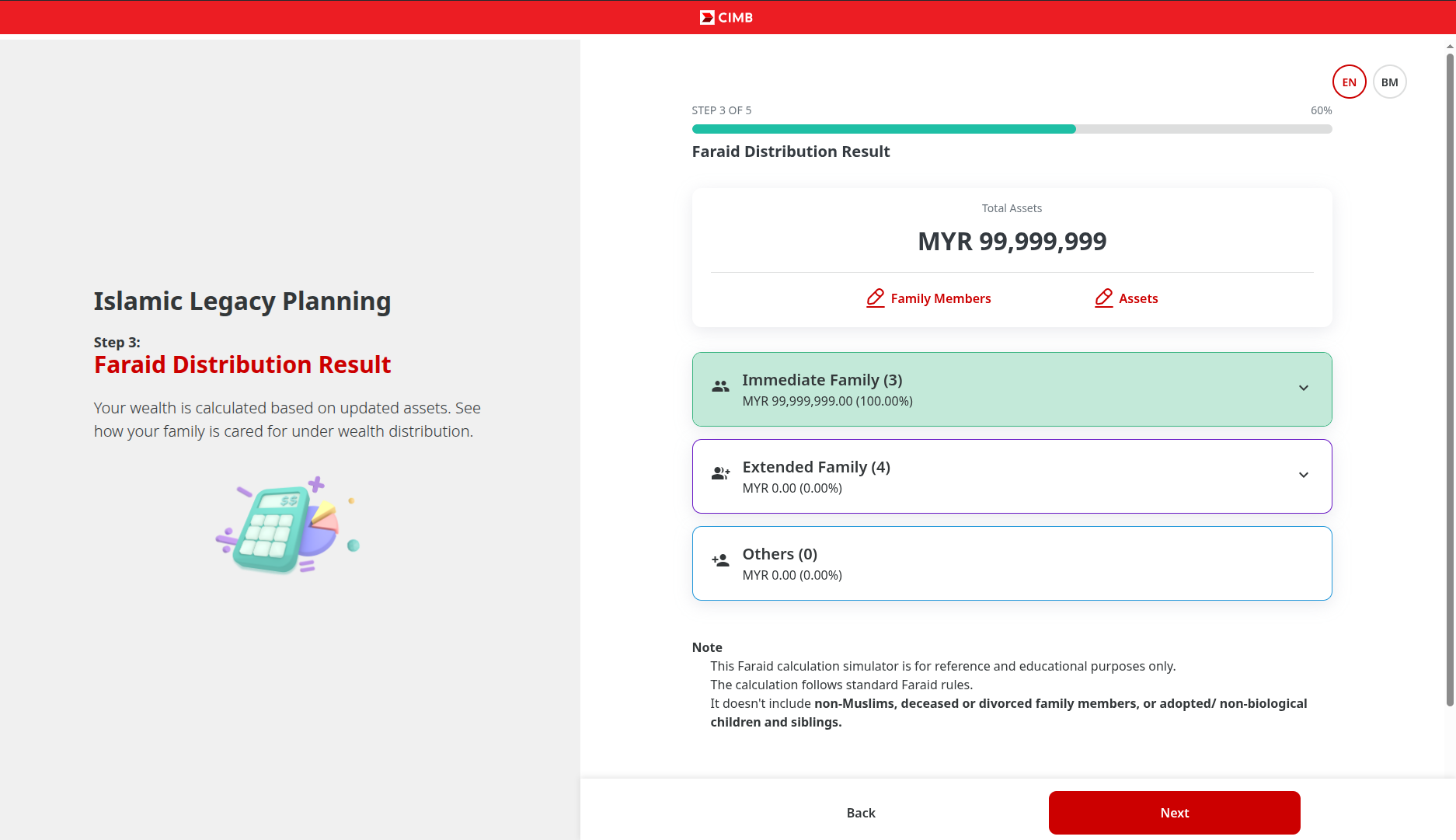
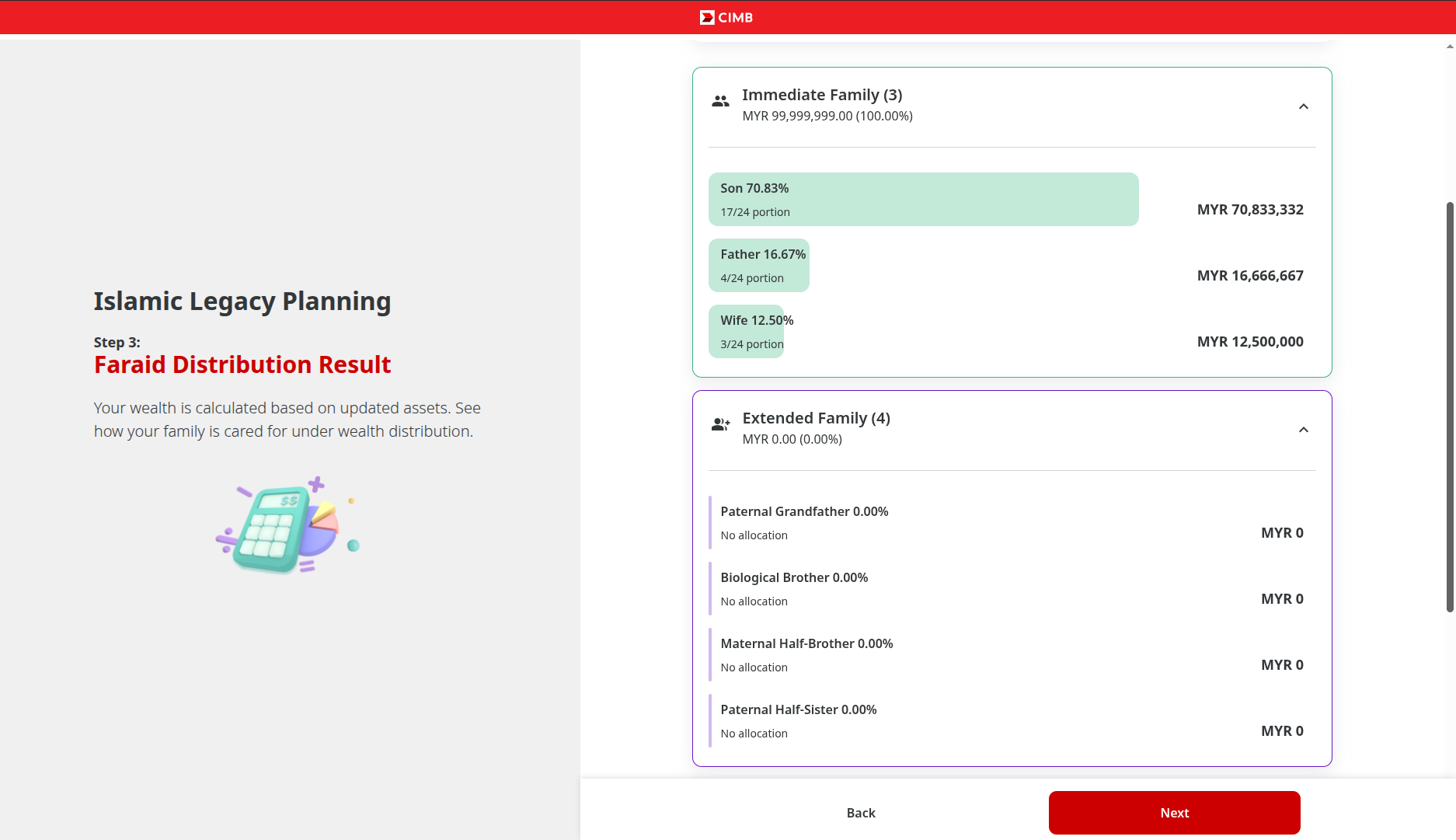
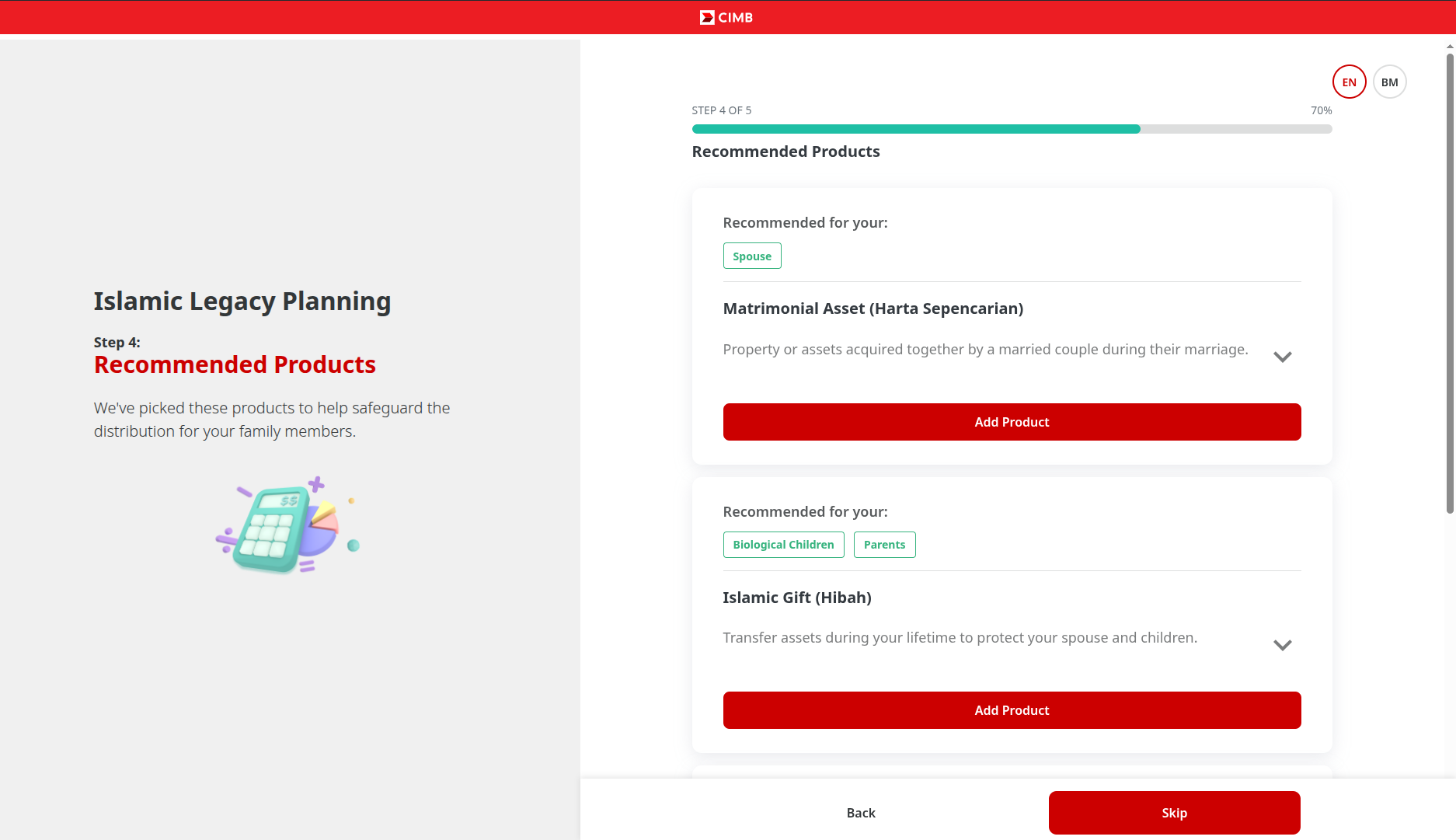
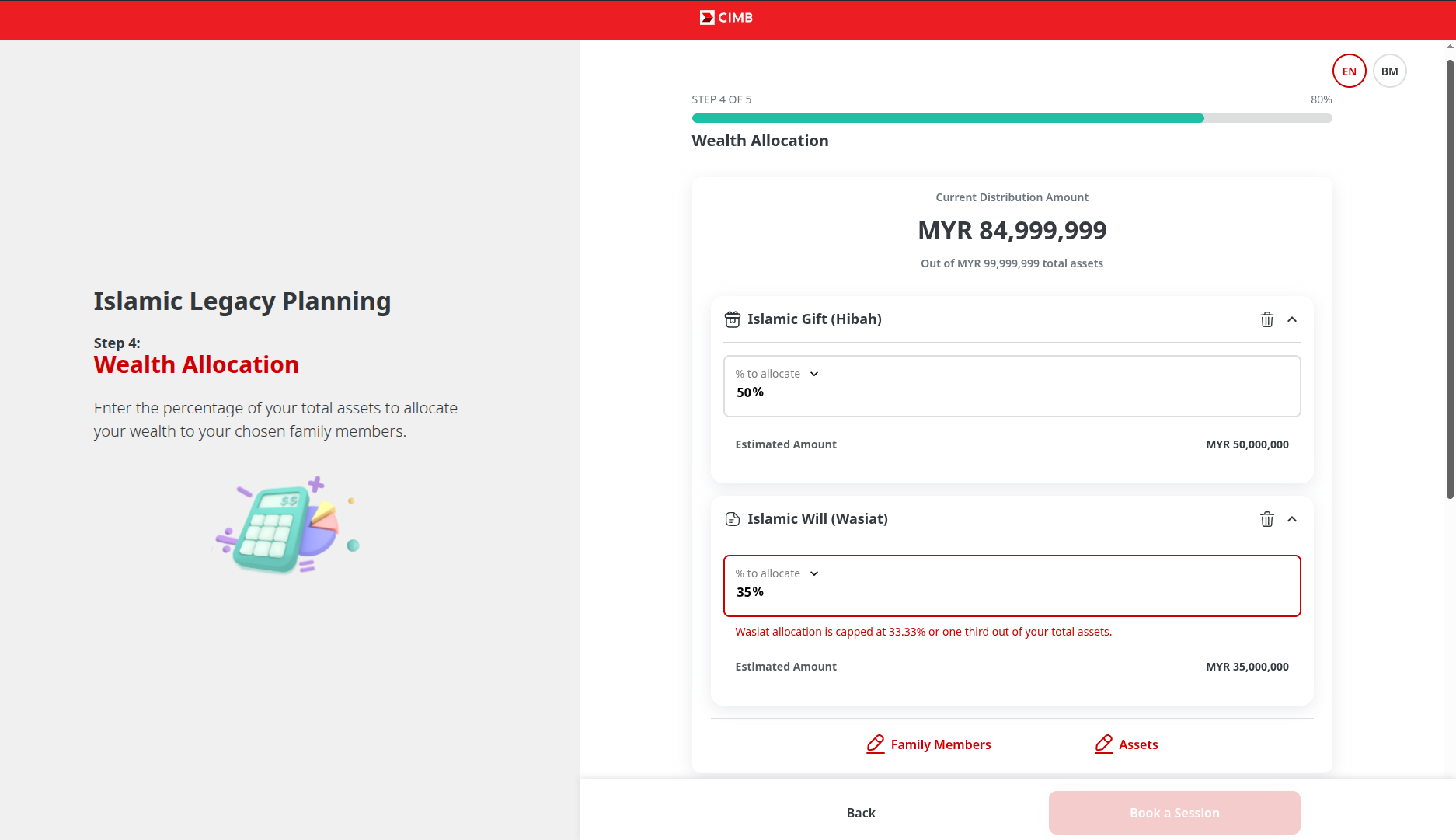
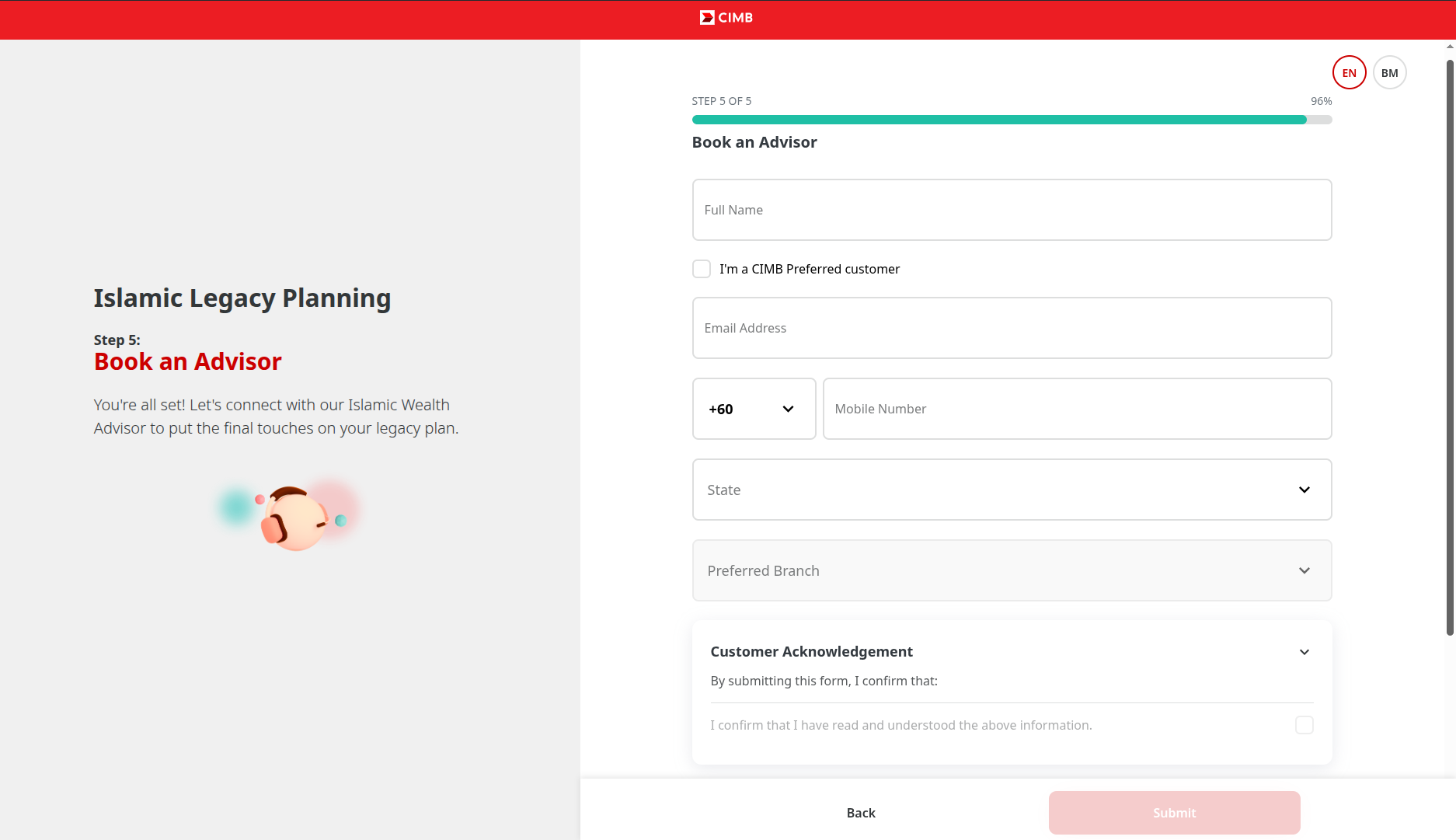
Faraid360 is Malaysia's first automated Shariah-compliant Faraid calculator, built end-to-end by a four-person internal team at CIMB Bank in just six months. I led the project in a triple role as Product Owner, Project Manager, and QA Lead, defining the product vision, managing delivery, and personally validating all 55 complex Shariah inheritance scenarios through workshops with Majlis Agama Islam Selangor (MAIS).
Faraid is the Islamic law of inheritance, prescribing fixed asset shares for eligible heirs based on the Quran and Hadith. What makes it deceptively difficult is the interaction of six mathematical concepts (fixed portions, residuary heirs, the 2:1 male-to-female ratio, blocking rules, proportional calculation methods, and proportional scaling when shares exceed the estate), all of which shift depending on exactly who survives the deceased. A single change in the family tree can cascade through the entire calculation. This complexity is precisely why an estimated RM65 billion in assets remain frozen and undistributed in Malaysia today.
What we built goes beyond a simulator. Faraid360 is a full legacy planning product. On top of the calculation engine, we layered a product recommendation system that reads a user's family structure and asset profile and suggests the right Islamic estate planning tools: Hibah to ring-fence assets for daughters, Harta Sepencarian to protect a surviving spouse's share of jointly-acquired property, and Wasiat for users with adopted children who fall outside Faraid entitlements entirely.
At CIMB's annual Simpler Better Faster Demo Day, attended by thousands of employees and the Group CEO, Faraid360 was voted the People's Choice Award, a recognition of the problem's scale, the product's clarity, and what a small, determined team can build when given room to move.
What is Faraid?
Faraid, derived from the Arabic word for "obligatory share", is the Islamic system of inheritance ordained through the Quran and Hadith, ensuring that a deceased Muslim's estate is distributed to rightful heirs according to divinely prescribed portions. It is legally enforced for Muslims in Malaysia under Syariah law.
But to understand why Faraid matters, you need to understand the problem it was solving.
The Philosophy: Equity, Not Equality
Across history, societies have wrestled with the same question: how do you divide a dead person's wealth without tearing the family apart?
Most ancient systems defaulted to one of two extremes. Equal division among all children sounds fair, but in practice, it fragments land and assets into economically unviable pieces while inviting endless sibling disputes over who gets what. At the other extreme, male-line primogeniture (the right of the eldest son to inherit the entirety of a family's estate) was widespread across medieval feudal Europe, deeply enmeshed with patriarchal values where power and property were perceived as male domains. In England, this practice was retained until very recently.
Ancient China leaned toward a related but distinct tension. The prize of total inheritance created an environment where the greatest threat to an heir wasn't outsiders, it was his own brothers.
Faraid offered a third way: structured, proportional distribution that gives every eligible heir a share (children, spouse, parents, and in some cases extended family) but in defined ratios rather than equal splits. The 2:1 male-to-female share ratio is frequently misunderstood as disadvantaging women, but must be read in its full context: under Faraid, a son inherits more because he also inherits the full financial obligation of supporting his wife and children. A daughter's share is hers entirely, with no obligation attached. The underlying principle is equity through responsibility, not equality through arithmetic.
Why Is It So Hard to Calculate?
The Islamic mathematician Al-Khwarizmi (c. 780–850 AD) wrote what is considered the world's first algebra textbook, with sections specifically on solving inheritance problems according to Islamic law. The word "algorithm" derives from his latinised name. Faraid was, in a very real sense, one of the original motivations for the invention of algebra.
Faraid involves six interacting calculation concepts:
- Fixed Portions (Furudhul Muqaddarah): Specific fractions (1/2, 1/4, 1/8, 1/3, 1/6, 2/3) prescribed in the Quran. These are non-negotiable and must be allocated first.
- Asobah (Residuary Heirs): After fixed portions are distributed, the remainder goes to residuary heirs (typically male relatives in a defined order) who receive what's left.
- 2:1 Ratio: Where male and female heirs from the same class co-exist, the male receives twice the female's share.
- Hijab (Blocking): Certain heirs can block others from inheriting entirely. A full brother is blocked if a son is present.
- Muqasamah: A calculation method for grandparents and siblings where the heir takes a proportional share rather than a fixed fraction.
- 'Aul (Proportional Scaling): When fixed-portion shares exceed the total estate, all shares are proportionally scaled down.
Each concept interacts with the others depending on who is alive at the time of death. Change one variable, and the entire calculation can shift.
The Scale of the Problem
As of the 2020 census, around 63.5% of Malaysia's population (over 20 million people) identified as Muslim. As of early 2025, approximately RM65 billion in assets (including real estate and cash) remain undistributed to heirs in Malaysia due to a lack of estate planning. AmanahRaya reports that only about 5% of Malaysia's population has engaged in any form of estate planning.
How We Built It
A 100% internal team of four: me, one frontend engineer, and two backend engineers. I wore every non-engineering hat simultaneously: Product Owner defining the vision and roadmap, Project Manager keeping sprints and stakeholder workshops on track, QA Lead writing and executing test cases across all 55 Shariah scenarios, and de facto designer. From kickoff to working product: 6 months. That speed was only possible because we made deliberate architectural choices, leaning into a new, lightweight tech stack and a simple deployment model that let us move without the usual enterprise overhead slowing us down.
Recognition
Faraid360 won the People's Choice Award, voted by over 40,000 CIMB employees. For a product built by four people, in six months, tackling one of the most mathematically and regulatory-complex problems in Islamic finance, I'll take it.