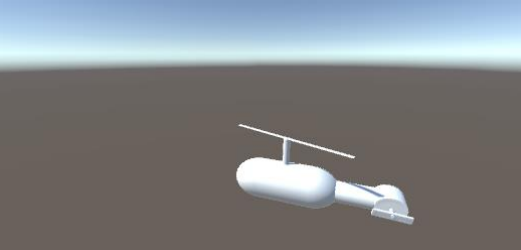
I built a real-time, interactive helicopter aerodynamics model in the Unity game engine using Blade Element Theory. It bridges the gap between slow engineering simulators and unrealistic video game physics. When benchmarked against MATLAB, it produced the exact same thrust and torque values, but executed in just 0.02 seconds (only 1.36% of MATLAB's compute time). Awarded 72/100 and published open-source under the MIT License.
The dissertation, 'Real-Time Low-Order Model of a Rotary-Wing Aircraft,' details the development of an interactive, physics-based helicopter simulation built entirely within the Unity game engine. The core objective was to bridge the gap between traditional engineering software (mathematically rigorous but computationally heavy and non-interactive) and commercial video game engines (real-time visuals but typically fake aerodynamic physics).
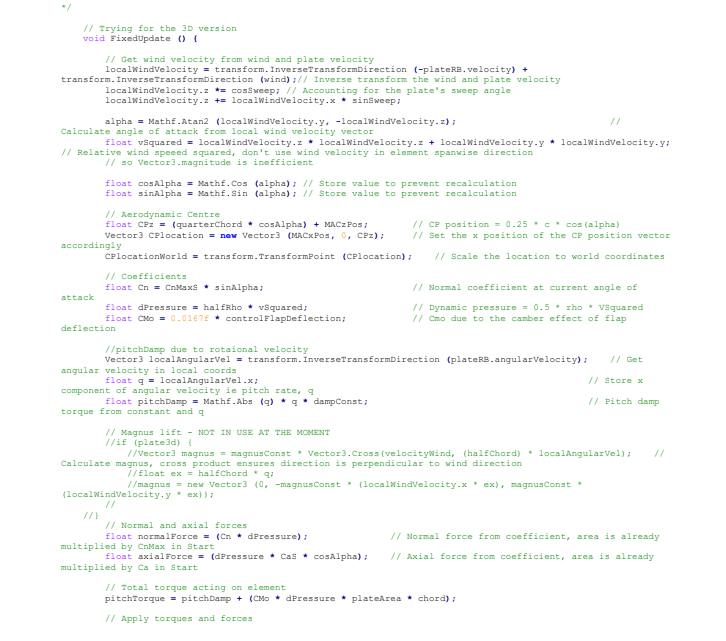
I utilised Blade Element Theory (BET) and C# scripting to compute dynamic aerodynamic forces on the fly, relying on Unity's native Nvidia PhysX engine. The project explored three distinct modeling approaches:
Method A (Aerodynamic Objects): A highly modular, object-oriented approach where independent plate elements are joined together manually. This allows for physical structural flex but naturally omits induced velocity effects.
Method B (Procedural Geometry): A script-driven implementation of Blade Element Momentum Theory (BEMT) that procedurally generates the rotor at runtime. This method successfully calculates induced velocity, capturing complex flight states.
Method C (Hybrid): An experimental paradigm attempting to combine Method A's structural modularity with Method B's real-time inflow calculations.
The testing phase strongly validated the model's accuracy and efficiency. When benchmarked against an industry-standard MATLAB BEMT solver, Unity's Method B produced the exact same thrust and torque values. Crucially, Unity completed these calculations in just 0.02 seconds. This open-source project proves that quantitatively accurate aerodynamics can be executed natively in real time, serving as a zero-cost, highly accessible tool for aerospace academics and game developers.