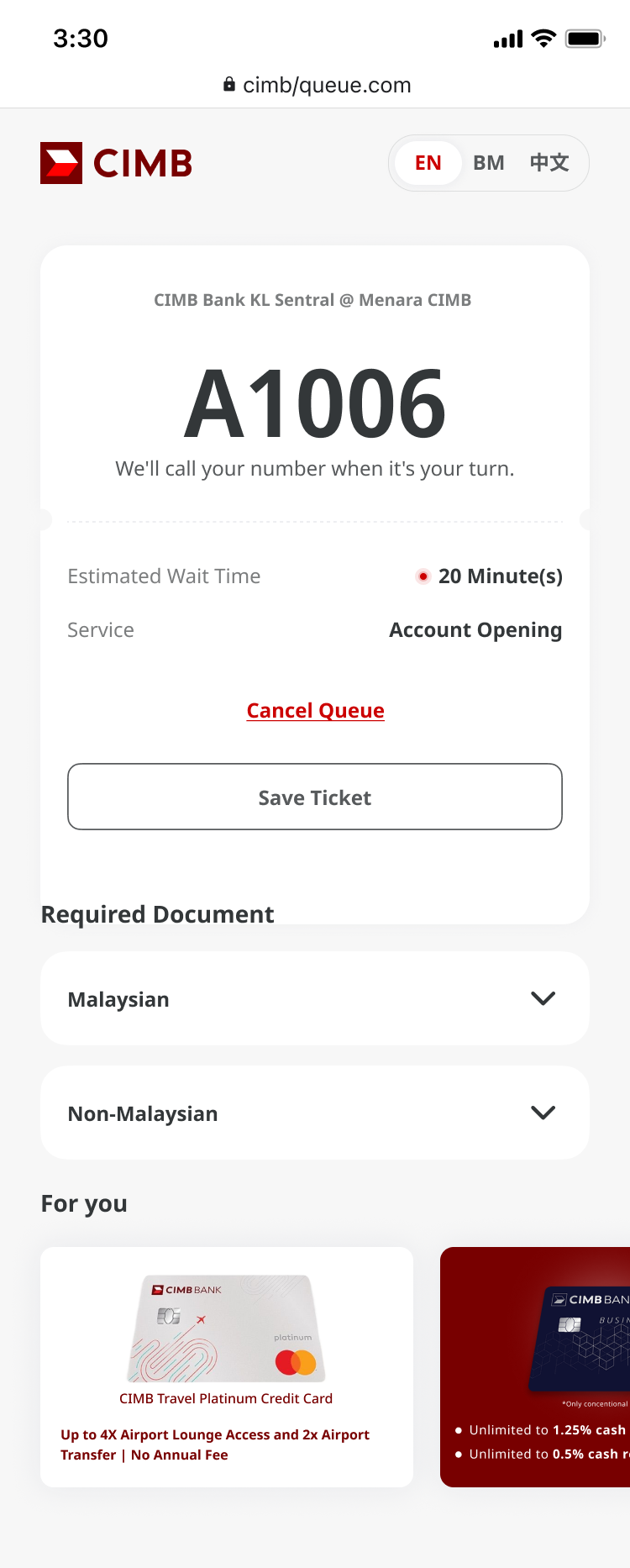
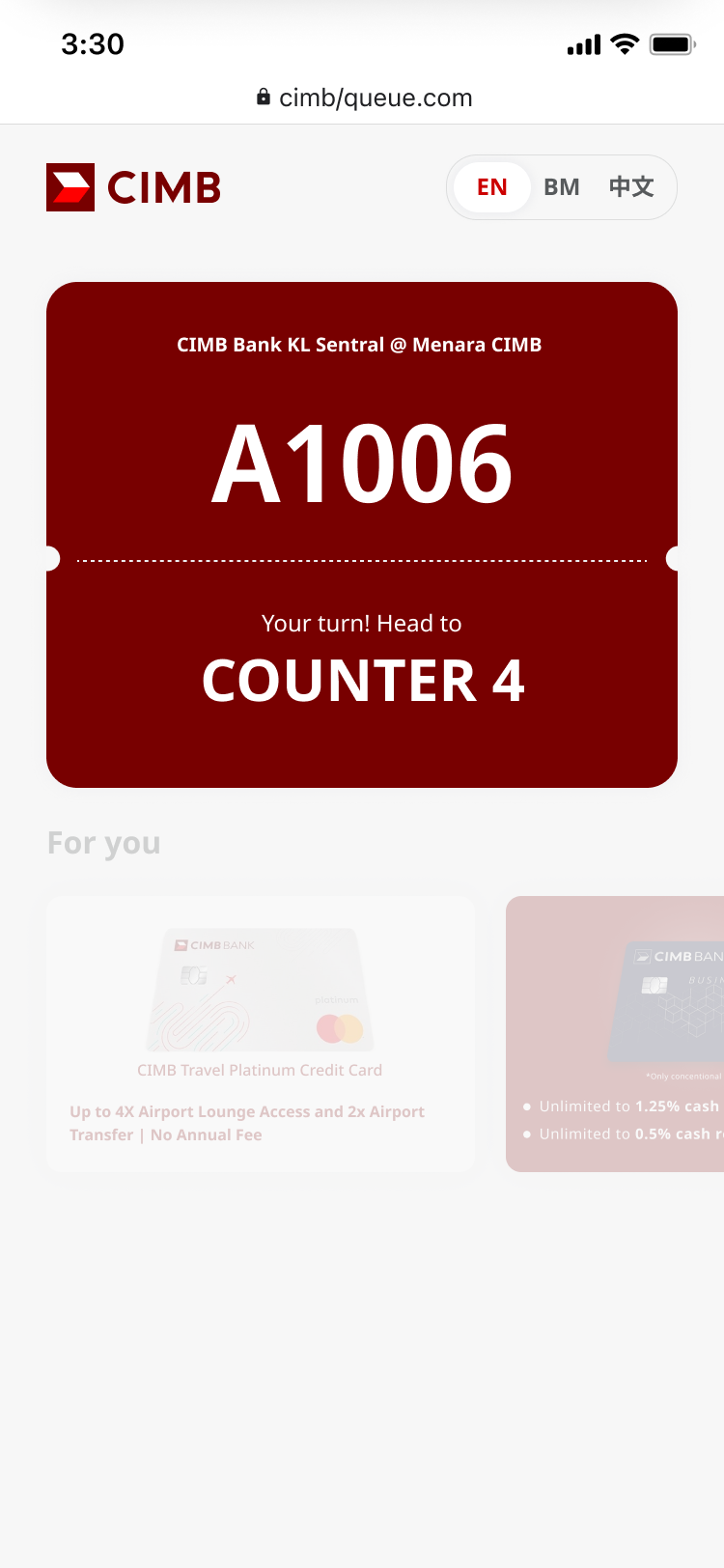
QueueGO is CIMB's internal initiative to transform the legacy Queue Management System (QMS) across all 217 Malaysian branches. It sits under the broader Branch Transformation program, with a projected contribution toward CIMB's RM2 billion Forward30 cost reduction target through self-service optimisation. I lead the product and technology workstream.
The current QMS is a vendor-provided, on-premise system that does one thing adequately: print tickets and call numbers. What it doesn't do is think. There's no intelligent triage to guide customers to the right service channel before they join the wrong queue. No real-time visibility into wait conditions. No connection between the queue and anything else the bank knows about its customers or its branches.
The underlying data makes this more frustrating: roughly 78% of branch transactions are routine. Average service time at the counter is one to three minutes. Long waits aren't caused by transaction complexity. They're caused by poor flow orchestration and a queue system that has no mechanism to fix it.
QueueGO's vision is to replace this with a smart branch entry point: a digital intake layer that captures customer intent on arrival, routes them intelligently to the right channel (self-service kiosk, Video Teller Machine, or staffed counter), and feeds a real-time control layer giving branch managers live visibility into queue lengths, traffic patterns, and staff utilisation.
The project is currently in active ideation and solutioning. Three Figma prototype iterations are complete across mobile and desktop. A technical feasibility study and reverse-engineering of the existing system have been completed. Two architectural paths are under evaluation: a cloud-based headless QMS provider, or a fully custom-built solution. The decision on architecture is next. Then the real work begins.
What is a Queue Management System, and Why Does It Matter?
Every time a customer walks into a bank branch, they encounter the same choreography: find the ticket machine, pull a number, find a seat, watch a screen, wait to be called. It's so familiar it's almost invisible. But underneath it is a surprisingly complex piece of infrastructure.
CIMB Bank operates 217 branches across Malaysia, serving over 8 million customers nationwide. Each branch runs a Queue Management System (QMS): the hardware and software layer that governs ticket issuance, service routing, teller calling, queue display, and branch reporting. It is simultaneously one of the most customer-facing systems in the bank and one of the least digitally evolved.
The Problem in Detail
Triage failure: When a customer walks in, the current system offers no meaningful guidance about which service path is right for them. Wrong selections are common, and by the time the error is discovered, the customer has already waited and the teller has consumed capacity on a misrouted ticket.
Invisible congestion: The current QMS doesn't surface real-time wait conditions. Queue build-ups happen silently until they're already a problem. There's no signal that tells a customer "Counter 3 is backed up, Counter 5 has no wait" because the system simply doesn't know how to communicate that.
It doesn't need to be this bad: Roughly 78% of branch transactions are routine: CASA account services, fixed deposits, deposits, and withdrawals. Average service time is one to three minutes. Long waits aren't caused by transaction complexity, they're caused by volume concentration and poor flow orchestration. Research shows that 75% of customers abandon a queue if wait time exceeds 10 minutes, and perceived wait time feels 36% longer when customers lack information about queue dynamics.
What QueueGO Is Trying to Build
The vision is a smart entry point to the entire branch. A digital intake layer captures intent on arrival. Based on the answer, the system routes customers intelligently: to a self-service kiosk for a routine transaction, to a Video Teller Machine for something that needs a human but not a physical counter, or to a specific service queue for something that genuinely requires staff. The queue number is just the output. The intelligence is in what happens before it's printed.
The system would feed a real-time branch control layer: live queue lengths, traffic patterns, kiosk utilisation, and staff allocation signals, giving branch managers data to respond dynamically. Longer term, the vision extends further: camera-based customer identification at entry, an AI recommendation layer in kiosks for light cross-sell moments, and full appointment booking integration.
Where We Are
Three Figma prototype iterations (V1 through V3) have been completed across mobile and desktop touchpoints. The team completed a technical feasibility study of the existing QMS infrastructure, including reverse-engineering the current QR-based queue flow. Two architectural paths are under evaluation: a cloud-based headless QMS provider with monthly subscription, or a fully custom-built solution. The next steps are requirements gathering and team establishment under the Consumer CX structure.
Why This Project Is Hard
QMS transformation sounds like infrastructure work. But the reason it hasn't been modernised despite decades of pain is precisely because of how deeply embedded it is. Every branch runs different hardware configurations. The system connects to a central HQ monitoring layer, a financial rates feed, an SMS notification gateway, and branch-level servers running the same software versions for years. Replacing the queue engine means coordinating a hardware refresh at over 200 branches, renegotiating vendor relationships, and doing all of this without disrupting daily operations. There's no big-bang switch. The transformation has to be phased, branch-by-branch, with a legacy fallback until confidence is established.